Familiar, monstrous, fantastically mundane.
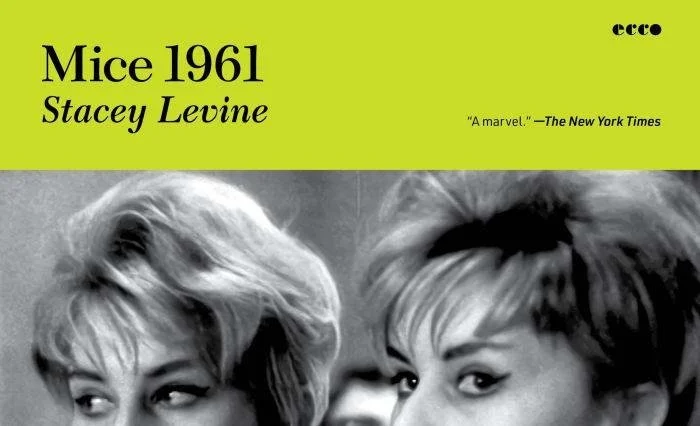
Published March 19, 2024 by Verse Chorus Press.
Stacey Levine is a wizard of language. Her prose is familiar but altered, like a dialect from an alternate universe, where you can’t quite pinpoint the skew, but it’s there nevertheless. Mice 1961 isn’t fancy or lyrical. It’s not going to mystify you with plot twists and dazzle you with descriptions, but if you’re looking for the kind of reading experience where you are staring into your own face in the mirror and wondering if you’ve ever actually met yourself before, or if you’ve been replaced by an exact duplicate, well here it is.
Stacey Levine is a wizard of control, of restraint, of epic smallness, and the ordinary weird. She examines straight seams and neatly parted hair and flat sidewalks, and comes up with beasts and dark diseases. This book belongs on the shelf beside Notable American Women by Ben Marcus and Irva and Alva, the Twins that Saved a City by Edward Carey, or maybe Ida by Gertrude Stein. If you don’t know those writers, then it’s likely that Mice 1961 is unlike any book you have ever read. And you might hate it.
Mice 1961 can be summarized as a day in the life of two orphaned sisters in Cold War era Florida. The older sister is anxious, and one younger one is bullied for her albinism. There is a beginning, middle, and end to the story, but there is also an exhaustingly chaotic and relentlessly slow and detailed description of a neighborhood potluck: who’s there, what they’re like, what they say to each other, what they’re eating. The book is almost unendurably flat and mundane, but in spite of this, maybe because of this, Levine’s hand on the rudder is operating with white-knuckle intensity. This is because there is a third character, the shadowy narrator, who is controlling and examining the story, operating the mechanics of it, obsessively observing it, and worrying about it. She exists in the tale, like some kind of understairs Nick Carraway or aggressively hairsprayed Lockwood, but her power over it and her place in it are constantly challenged by the characters, and put in flux by her own desires to float or intervene. Weird. Interesting.
I have been devouring Stacey Levine’s work since the 90s when I met her in Chicago. Her short story collection, My Horse and Other Stories, is on my top shelf with The Intuitionist and Geek Love and Observatory Mansions, all books that clear the path, then tap on your forehead and let you know what’s possible. Mice 1961 was originally published by Verse Chorus Press a few years ago, but is being reprinted by Ecco Books (now with an audiobook expertly performed by Jane Oppenheimer) because it was a Pulitzer Prize finalist. Wonderful news for all of us lovers of experimental forms! I hope it finds many more readers, because I want Stacey Levine to write many more books. I will always read them, and puzzle over them, wrestle with them. They never fail to surprise me.
